

Where to Find Authentic African Fabrics for Your Wardrobe
Last Updated: October 30, 2026
Quick Summary
You can find authentic african fabrics through online stores, in-person markets and fabric shops, or direct sourcing, and the safest buys come from sellers who name the country of origin, show the selvage edge, and state the fiber content. Verify any fabric with the selvage mark, a burn test on a loose thread, and a color rub before you pay.
- Wax print traditionally comes as a six-yard piece, enough for a full dress or a shirt plus trousers.
- The burn test on a loose thread separates cotton, which smells like paper, from polyester, which melts into a bead.
- Urbanstax lists Nigeria, Ghana, South Africa, and Tanzania among its fabric sources.
- The Afrikan Fabric Shop advertises savings on purchases of ten or more yards.
- Pre-wash cotton before sewing, because it shrinks and you do not want that after the garment is finished.
Table of Contents
- Where to Find Authentic African Fabrics: Online, In Person, and Direct
- African Fabric Types and Patterns You Will See Everywhere
- How to Identify Authentic African Fabric Before You Pay
- Buying African Fabric by the Yard: Quantities, Prices, and Shipping
- Country and Region: Matching the Print to Its Source
- In-Person Buying: Markets, Fairs, and Fabric Shops
- The Buyer Checklist for Quality, Care, and Suitability
- Why Buying Ready-to-Wear Saves You Time and Fabric Waste
- Start Your Search With a Store That Shows Its Sources
- Frequently Asked Questions
Where to Find Authentic African Fabrics: Online, In Person, and Direct
If you have ever ordered "authentic" African fabric online and opened a package of thin, shiny polyester, you already know the problem. The global market for African textiles is estimated at USD 1.85 billion in 2026, projected to reach USD 2.28 billion by 2034 according to Africa Textile Market Size, Share & Trends, 2034, and that growth has pulled in a lot of sellers who use the word "authentic" loosely. Customers often ask where to find authentic African fabrics without getting burned. This guide covers the three real channels, online stores, in-person markets, and direct sourcing, plus how to tell the difference before you pay.
The short answer: buy from sellers who name the country of origin, show the selvage edge, and state the fiber content. Everything else is guesswork.
Below, we walk through fabric types, verification tests, yardage math, and a buyer checklist you can carry on your phone.
African Fabric Types and Patterns You Will See Everywhere
African print fabric covers a family of textiles, not a single product. The most common types you will encounter are:
- Ankara / wax print: Cotton fabric with a wax-resist dyed pattern, sold in six-yard pieces and widely used for dresses, shirts, and tailoring.
- Kente: Woven cloth with geometric bands, traditionally associated with West Africa and often sold in narrower strips.
- Kitenge: A wax-print style textile common in East Africa, similar in construction to Ankara but often with different pattern conventions.
- Mud cloth: Hand-painted or dyed cotton with earthy, graphic motifs, heavier in hand than wax print.
One point worth stating plainly: some researchers question whether Ankara prints are "authentically African" in origin, since the wax-resist technique has a complicated colonial-era history even though the fabric is now produced and worn across the continent. That debate does not make the fabric less African today. It does mean you should ask where a specific bolt was printed, not just whether the pattern "looks African."
How to Identify Authentic African Fabric Before You Pay
Authentic African fabric is cotton-based cloth printed or woven in Africa, and you can verify it through the selvage, the fiber, and the color before money changes hands. Kahindo's fabric identification guide recommends checking selvage marks, running a fiber test, and assessing color fastness, and those three checks catch most fakes.
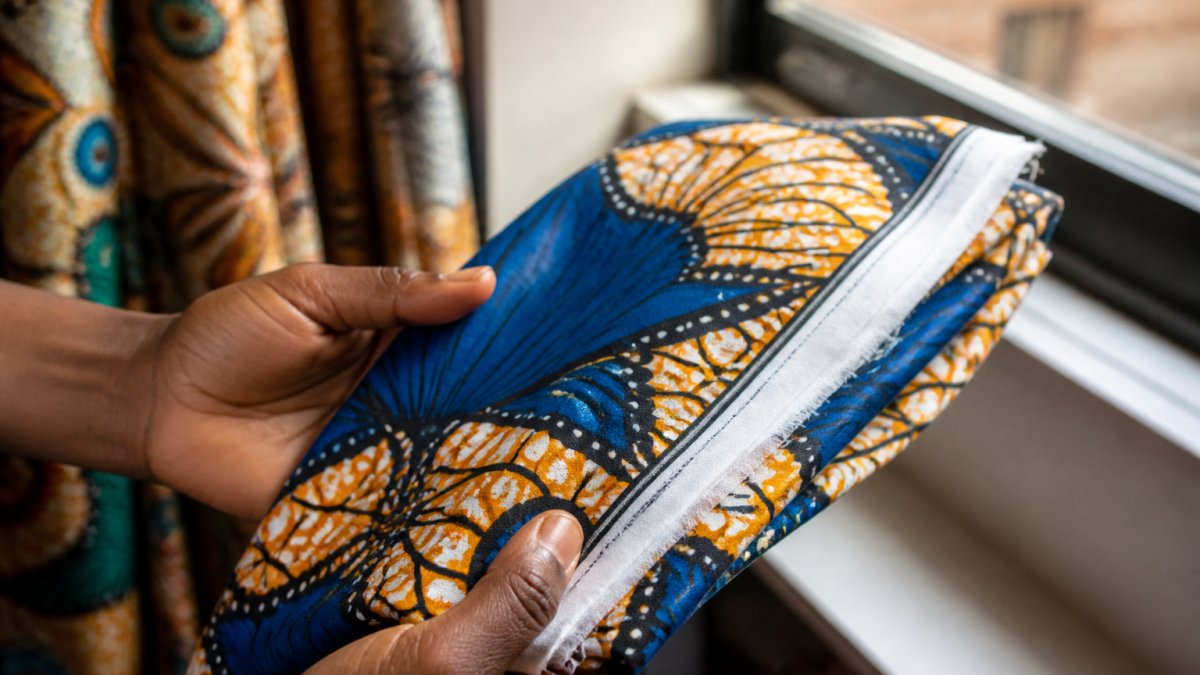
Here is how to identify authentic African fabric in practice:
- Read the selvage. The finished edge of real wax print usually carries a manufacturer mark, a design number, or a "Guaranteed Wax" style stamp. Blank, cut-off selvage is a warning sign.
- Do the burn test on a loose thread. Cotton ash crumbles and smells like paper. Polyester melts into a hard bead and smells chemical. Do this on a scrap, never on the yardage.
- Check the reverse side. Real wax print shows the pattern on both faces with slight registration differences. Cheap digital prints often have a pale, washed-out back.
- Rub the color. A white tissue rubbed firmly on the fabric should stay mostly clean. Heavy transfer means poor dye fixation.
Buying African Fabric by the Yard: Quantities, Prices, and Shipping
African fabric by the yard is sold either as a cut length or as a full piece, and the difference matters for both price and project planning. Wax print traditionally comes as a six-yard piece, which is enough for a full dress or a shirt plus trousers. Many online sellers will cut by the yard, but the per-yard price is usually higher than the piece price.
Ask three questions before checkout:
- Is the price per yard or per piece? A "six yards for one price" listing is not comparable to a per-yard listing until you divide it out.
- What is the shipping cost and who pays duties? International shipping can add meaningfully to the landed cost, and import charges are the buyer's responsibility.
- Is there a discount for bulk? The Afrikan Fabric Shop advertises savings on purchases of ten or more yards, a common structure among fabric retailers.
We recommend buying one yard first from any new seller. It costs little and tells you more about hand, weight, and color accuracy than any product photo.
Country and Region: Matching the Print to Its Source
Country of origin is the fastest authenticity filter available to you, and good sellers publish it. Urbanstax states that its fabrics are made in Africa and lists Nigeria, Ghana, South Africa, and Tanzania among its sources, which is the level of transparency to look for. But "made in Africa" is a starting point, not an answer. The continent's textile trade runs through a handful of distinct production and market hubs, and knowing them tells you what to expect in the hand, how the cloth will behave when you sew it, and what questions to ask.
Here is how the major sourcing regions differ in practice:
- West Africa (Nigeria, Ghana, Senegal, Mali): This is the deepest wax-print market. Mali is the home of bogolanfini (mud cloth), which is hand-painted or hand-dyed and should look and feel irregular, not machine-perfect.
- East Africa (Tanzania, Kenya, Uganda): Kitenge and kanga dominate. Tanzanian kitenge is commonly sold in two-yard and four-yard cuts as well as six-yard pieces, and the cloth often runs lighter than West African wax print. Kanga, the paired rectangular cloth with a printed proverb, is a distinct product from kitenge and is usually sold as a matched pair.
- Southern Africa (South Africa, Zimbabwe, Zambia): South Africa has a formal retail and mill sector alongside informal markets, and Shweshwe (a printed cotton with a distinctive discharge-print style) is the textile most associated with the region. Shweshwe is typically sold in narrower widths and is known for a stiff hand that softens with washing.
- North and Central Africa: Kente weaving is most associated with Ghana's Ashanti region, while Central African regions produce raffia and barkcloth traditions that are sold more often through craft and art channels than through fabric retailers.
Why does the country matter? Because pattern conventions, fabric weight, and print quality vary by production region, and the same "Ankara" label can cover a heavyweight Ghanaian wax print and a thin commodity print from an unnamed mill. Neither is automatically "better," but knowing the source tells you what to expect in the hand and how the cloth will behave when you sew it.
A practical way to use this: when a listing names a country, ask a follow-up question about the mill or the market. Sellers who source from Balogun or Makola can usually describe the stall or the distributor. Sellers who source from a jobber may only know the country of printing, not the country of finishing. Both answers are useful; the vague one is not.
If a listing says only "African print" with no country, treat that as missing information rather than a dealbreaker. Ask the seller directly. A retailer who sources honestly can usually answer within a day. If you are comparing two sellers at the same price, the one who can name the region and the print method is the safer buy.
Knowing the region tells you what to expect in the hand and how the cloth will behave when you sew it.
| Region | Countries | What you will find |
|---|---|---|
| West Africa | Nigeria, Ghana, Senegal, Mali | Deepest wax-print market; Mali home of bogolanfini mud cloth |
| East Africa | Tanzania, Kenya, Uganda | Kitenge and kanga; kitenge sold in two, four, six-yard cuts |
| Southern Africa | South Africa, Zimbabwe, Zambia | Shweshwe printed cotton in narrower widths, stiff hand |
| North and Central Africa | Ghana (Ashanti), Central Africa | Kente weaving; raffia and barkcloth via craft channels |
In-Person Buying: Markets, Fairs, and Fabric Shops
Buying in person remains the strongest verification method because you can touch the cloth, compare bolts side by side, and ask the vendor questions face to face. Most of the visible results for this query are online product listings, so practical in-person guidance is thin. Here is how to work a market, a fair, or a fabric shop without wasting a trip.
Know the venue types. Three kinds of in-person sources matter, and they behave differently:
- Dedicated fabric markets and districts. These are the deepest inventories and the best prices per yard, but quality varies stall to stall. Expect to negotiate on multi-piece purchases and to pay cash for the best price.
- African and Caribbean cultural festivals and craft fairs. Vendors here often sell the same stock they ship online, and because they are set up for a weekend, they are usually willing to talk about origin. Selection is narrower than a market, but the conversation is better.
- Independent fabric and sewing shops. These carry less wax print but often stock garment-weight cotton, lining, and notions you will need for a project. Staff can tell you about shrinkage and care for the specific bolt.
Work the stall in a fixed order. At a market stall or fabric shop, run the same checks you would online, just faster:
African Ankara Wax Print Backpack School Bag →
- Hold the fabric to the light. Uneven print density and thin spots show up immediately.
- Crumple a corner in your fist and release it. Cotton wrinkles and recovers; polyester springs back flat.
- Rub a white tissue firmly across the print. Heavy color transfer means poor dye fixation.
- Check the selvage for a manufacturer mark, design number, or "Guaranteed Wax" stamp.
- Ask the vendor where the bolt was printed. Vague answers are information.
- Check the cut edge for fraying. Cleanly finished edges suggest better mill quality.
Ask about quantity before you fall in love with a bolt. Wax print is traditionally sold as a six-yard piece, but market vendors will often cut by the yard at a higher per-yard price. Confirm whether the quoted price is for the full piece or a cut, and confirm the width, because bolt widths vary and your pattern assumes a specific one. Bring a small tape measure and note the width on your phone.
Negotiate on bundles, not on single yards. A common pattern is a discount once you commit to two or more pieces or ten or more yards. Ask what the price is for the bundle rather than haggling down a single cut; vendors protect margin on singles and move on bundles.
Plan for the practical side. Markets are cash-friendly and card-unfriendly; bring cash and a tote. Parking and crowds are real constraints on weekend market days, so go early. If you are buying for a specific project, bring the pattern envelope or a photo of the garment so the vendor can advise on yardage.
Cultural festivals and craft fairs are underrated sources, since many vendors sell the same stock they ship online and will happily discuss origin face to face. If you find a vendor whose answers are specific, get a card; that relationship is worth more than a one-time discount.
The Buyer Checklist for Quality, Care, and Suitability
Run this checklist before you commit to any purchase, online or in person:
- Seller names the country of origin
- Fiber content is stated as a percentage, not just "cotton"
- Selvage edge is visible in at least one photo
- Price basis is clear (per yard vs. per piece)
- Shipping cost and duty responsibility are stated
- Return policy covers color and hand-feel mismatch
- Care instructions are provided
- Reviews mention actual construction, not just delivery speed
On care: cotton wax print generally washes well in cold water and holds color longer if you turn it inside out and skip the dryer. Pre-wash before sewing, because cotton shrinks and you do not want that happening after the garment is finished.
Why Buying Ready-to-Wear Saves You Time and Fabric Waste
Here is the part most fabric guides skip. Buying yardage only makes sense if you sew or have a tailor lined up. For everyone else, ready-to-wear removes the two biggest hidden costs: leftover fabric and remake cycles.
A six-yard piece rarely maps perfectly onto a pattern, so most home sewers end up with offcuts they never use. And when the fit is wrong, you have already spent the money on fabric and labor. Ready-to-wear skips both problems, and you can see the finished silhouette before you buy.
Our Ankara and Asoke kimono is a layering piece that pairs with skirts, pants, or worn alone. If you want a single statement garment, the Princess long dress is cut from premium 100% Ankara cotton. For men, the collarless men's cotton shirt is made from cotton Ankara fabric, and the Asoke palazzo pant has an elastic waist.


Start Your Search With a Store That Shows Its Sources
The fastest way to find authentic African fabrics is to buy from a seller who volunteers origin, fiber, and construction details without being asked. That transparency is the whole game.
As Verna Yeboah put it in a review of our work: "The fabric feels luxurious, the design is unique, and the attention to detail is unmatched."
You can browse the full collection to see how each piece is described, including fiber content and sourcing notes.
Frequently Asked Questions
Where can I buy authentic African fabrics online?
Start with sellers who name the country of origin for each print and show close-up photos of the fabric, including the selvage edge. Look for shops that sell by the yard or meter, publish material content such as 100% cotton, and state a return policy. Avoid listings that only use the word authentic without any sourcing detail.
How can you tell if African wax print fabric is authentic?
Check the selvage edge for printed manufacturer marks and a repeating pattern that aligns cleanly on both sides. Real wax print has color that goes through the cloth, so the reverse side shows a slightly softer version of the same design. Rub a small corner with a damp white cloth to test color fastness. Ask the seller for the fiber content and country of origin. A seller who answers those questions with specifics is a better sign than any label alone.
What is the difference between Ankara and African wax print?
Ankara is the name many shoppers use for the wax-printed cotton cloth worn across West Africa, especially Nigeria. African wax print describes the printing method and the family of fabrics. One search result notes that Ankara prints might not be authentically African in origin, while also describing them as one of many textiles used across Africa. In practice, Ankara refers to the finished printed cotton you buy by the yard, while wax print describes how the pattern is applied.
Which African fabrics are made in Africa?
Many are, but the label matters more than the pattern. Kente, mud cloth, and Kitenge are produced in specific regions, and sellers should tell you where. Ask whether the cloth was woven or printed locally, and whether the seller works with local workers or through direct sourcing. A print that looks African can still be manufactured elsewhere, so confirm the origin before you buy.
What should I look for when buying African fabric by the yard?
Confirm the width and the unit, since some sellers quote by the yard and others by the meter. Check the fiber content, such as 100% cotton or a cotton blend, because that changes how the fabric drapes and washes. Ask about color fastness and shrinkage. Bulk pricing is worth asking about. Order a small cut first if you are testing a new seller.
Is African wax print fabric always made in Africa?
No. Wax print cloth is produced in several countries, and some prints sold as African are manufactured elsewhere. That is why origin questions matter. If origin matters to you, ask the seller to name the country where the cloth was printed or woven, and look for shops that publish that detail on each listing.
How much does authentic African fabric cost per yard?
Prices vary by fiber, print complexity, and seller. Prices reflect fiber, print complexity, and seller, rather than a single price point. Compare the price per yard against the fiber content and origin details before deciding.
Finding fabric you trust should not require a chemistry kit and three return labels. African Dazzle Boutique curates ready-to-wear African-print clothing made from heritage-driven patterns and contemporary silhouettes, with inclusive sizing, 100% cotton fabrics on select items, and pieces built for both festivals and the office. Get started with African Dazzle Boutique and wear your heritage with confidence.
