

Styling African Print for Professional Settings: A Workwear Guide
Last Updated: November 1, 2026
Quick Summary
Styling african print for professional settings means limiting bold pattern to one garment and letting fit, fabric, and neutral color do the rest. Choose one focal piece, ground it with quiet neutrals like cream, grey, navy, or white, and keep accessories modest.
- Small-scale muted prints suit formal offices; large bold prints fit creative workplaces.
- A tailored print blazer over a solid base is the most office-safe way to wear bold print.
- Check that shoulder seams sit at your shoulder bone and pencil skirts hit mid-knee.
- Look for mid-weight cotton of roughly 4 to 6 ounces per square yard that holds its shape.
- Wash print garments cold and inside out, skip the dryer, and iron on the reverse.
Table of Contents
- How to Style Ankara for Work Without Looking Like You're Headed to a Festival
- African Print Work Outfits: Five Formulas That Hold Up in an Office
- The African Print Blazer Outfit: Your Fastest Route to Business Casual
- Accessorizing African Print Clothing for the Office
- Fit, Fabric, and Care: What Separates Polished From Sloppy
- Build Your Work Rotation From African Dazzle Boutique
- Frequently Asked Questions
How to Style Ankara for Work Without Looking Like You're Headed to a Festival
African print workwear works best when you treat the fabric as tailoring, not costume. The print is rarely the problem. The styling is.
Below, we break down how to style Ankara for work across dress codes, with five outfit formulas, accessorizing rules, and the fit and fabric details that separate polished from sloppy.
Match Print Scale to Your Workplace Formality
Print scale is your first dial. Small, dense motifs read calmer than large, high-contrast ones. In a conservative office, a small-scale print in muted tones blends in.
Match the scale to the room:
- Formal or client-facing: small-scale print, muted print, or a print used only as trim
- Business casual: medium-scale print on one piece, paired with navy, grey, or cream
- Creative or casual office: large-scale bold print as the statement piece
When in doubt, go one step quieter than you think you need. Nobody has ever been pulled aside for a print that was too subtle.
Pick One Focal Point and Let Neutrals Do the Rest
One focal point per outfit. That is the whole system.
If the print is loud, everything else stays quiet. Neutral tones like cream, grey, navy, and white give vibrant colors somewhere to land. A white shirt under a print blazer, or a plain knit over a print skirt, keeps the look sophisticated instead of chaotic.
African Print Work Outfits: Five Formulas That Hold Up in an Office
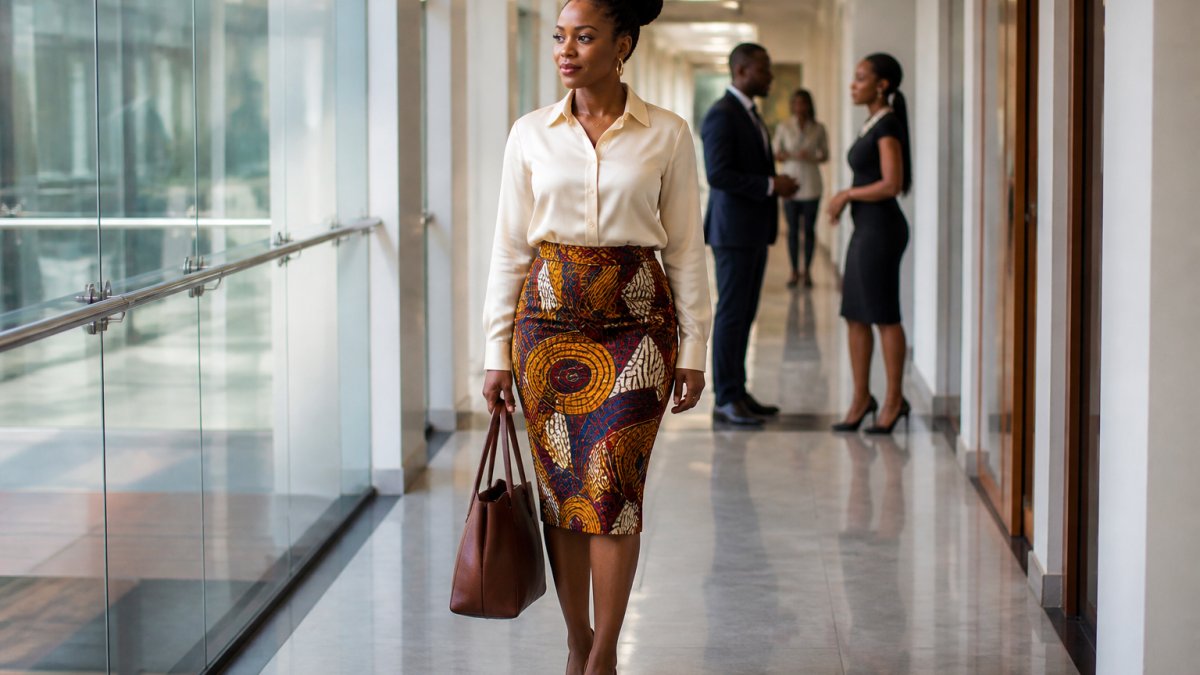
Each formula keeps a single print piece as the focal point and builds a complete, office-ready look around it. Rotate them through your week and you have an everyday wardrobe that never repeats itself.
Formula 1: Print Shirt, Neutral Trousers
The easiest entry point. Pair an African print shirt with neutral trousers in navy, grey, or cream.
Our collarless cotton Ankara shirt gives you a clean neckline that suits this look. For the trouser side, our lightweight Asoke palazzo pants give you a relaxed option with an elastic waist.

Formula 2: Print Skirt, Solid Knit or Blouse
A print pencil skirt or midi with a solid top is the most versatile combination in this guide. The skirt carries the color. The top keeps it calm.
Keep the blouse simple: a solid knit, a white shirt, or a fine-gauge sweater. Avoid a second pattern up top.
Formula 3: Print Two-Piece Set, Worn as a Suit
A matching print set worn together reads like a suit, and a suit reads professional. This is the fastest way to look intentional without much effort.
Our IREDE crop top and pant set in 100% Ankara cotton works as a coordinate that does the styling for you.

Formula 4: Print Blazer Over a Solid Base
Covered in full in the next section. Short version: a tailored print blazer over a plain base is the most office-safe way to wear bold print.
Formula 5: Print Dress, Belted and Layered
A structured African print dress works in most offices when you belt it at the waist and add a neutral layer, a cropped cardigan, plain blazer, or longline vest. Keep shoes and bag quiet so the dress stays the focal point.
The African Print Blazer Outfit: Your Fastest Route to Business Casual
The African print blazer outfit is the single most useful piece in a professional print wardrobe. A tailored blazer in Ankara instantly dresses up a plain base without demanding a full print look.
Here is how to wear it well:
- Start with a solid base: a white shirt, a grey knit, or a navy shell
- Choose a blazer in a muted print or a small-scale pattern for conservative offices
- Keep the fit sharp at the shoulder and hem
The blazer also solves the "I need to dress up for a meeting" problem. Throw it over an ordinary outfit and you are ready.
Accessorizing African Print Clothing for the Office
Accessories make or break a print outfit. The rule is simple: when the print is bold, the accessories stay quiet. When the print is muted, you have room to add a little shine.
Jewelry, Bags, and Shoes That Stay Quiet
Keep metals consistent and sizes modest. Pick gold or silver and stay with it. Small studs, a thin chain, and a simple watch do more than a stack of statement pieces.
Ankara|Short Dress|Asoke Trim →
For bags and shoes, lean on neutrals:
- Shoes: black, nude, tan, or navy pumps, loafers, or flats
- Bag: a structured tote or shoulder bag in a solid neutral
- Belt: match the shoe color for a clean line
This is where most people overdo it. The print already draws the eye. Everything else should support it, not compete.
Head Wraps, Braided Wigs, and Office-Appropriate Finishing
A head wrap can absolutely work in a professional setting. Keep the wrap in a solid color or a small-scale print that echoes your outfit, and tie it neatly.
Braided and cornrow wigs are another option for a finished look. Choose a length and style that suits your workplace, and keep the edges neat.
Fit, Fabric, and Care: What Separates Polished From Sloppy
Fit is the difference between a print piece that looks expensive and one that looks thrown on. A well-fitted garment in a modest print beats a loose one in a bold print every time.
Here is what to check before you wear a print piece to work, and what to look for when you buy one.
Fit: Three Checks That Matter Most
Most fit problems in print garments come down to three areas. Check these before you leave the house:
- Shoulders and seams: the shoulder seam should sit at your shoulder bone, not past it. A dropped shoulder in a stiff print fabric reads as a size too big.
- Length: a pencil skirt that hits mid-knee reads professional; one an inch above reads casual in a conservative office. Check the hem from the side, not just the front.
- Drape: stiff, heavy fabric stands away from the body; good cotton falls cleanly. If the garment stands away at the waist or hip, it is either too heavy or too large.
A common pattern is that print garments are cut generously to accommodate the pattern repeat. That means your usual size may be too loose. Try one size down before you assume the fit is wrong.
Fabric: Weight, Weave, and What to Look For
Fabric matters as much as fit. The same print can look polished in one fabric and sloppy in another.
- Weight: mid-weight cotton (roughly 4 to 6 ounces per square yard) holds its shape through a workday. Lightweight cotton wrinkles and clings; heavyweight cotton stands away and feels stiff.
- Weave: a tight plain weave or fine twill reads more formal than a loose weave, which shows the pattern less crisply and snags easily.
- Stretch: 2 to 5 percent elastane helps a pencil skirt or fitted blouse move with you; all-cotton fitted silhouettes can restrict movement.
Our Ankara short dress with Asoke trim is made from cotton.

Construction: Seams, Closures, and Finishing
Construction details separate a garment that lasts from one that falls apart after a few wears. Look for these when you buy:
- Seam finishing: serged or bound seams prevent fraying and extend life. Unfinished seams inside a print garment are a warning sign.
- Closures: a hidden zipper or well-set button placket reads more formal than an exposed zipper. Check that buttons are secure and the placket lies flat.
- Pattern matching: on a well-made garment, the pattern matches at the center front, side seams, and sleeve caps. Mismatches signal rushed construction.
Care: Keeping Print and Color Intact
Laundering a structured cotton print without care can shrink it or dull the colors. Follow the care label, and if you use a cleaners, ask for a light starch rather than a heavy one. Over-starched fabric cracks and looks worn.
A few practical rules for print garments:
- Wash cold, inside out. Hot water fades print colors and shrinks cotton. Turn the garment inside out to protect the print surface from abrasion.
- Skip the dryer or use low heat. High heat is the fastest way to shrink a cotton print and set wrinkles. Hang or lay flat to dry when you can.
- Iron on the reverse. Press the garment inside out or use a pressing cloth to avoid scorching the print. A hot iron directly on a print can leave a shine that never comes out.
Durability and Responsible Sourcing
A print piece that lasts five years is more sustainable than three that last one year each. Look for garments constructed to be altered and cared for, not discarded: generous seam allowances, secure closures, and fabrics that wash without losing their finish.
That is the standard we design to at African Dazzle Boutique: print pieces that fit well, hold their shape, and carry your culture into the office for years, not one season.
Here are the fabric and construction benchmarks the article says to check before wearing or buying a print piece for work.
| Item | Value | Note |
|---|---|---|
| Cotton weight | Roughly 4 to 6 ounces per square yard | Mid-weight holds shape through a workday |
| Stretch | 2 to 5 percent elastane | Helps fitted pieces move with you |
| Hem allowance | 1.5 to 2 inches | Gives room to let down or take up |
| Shoulder seam | At your shoulder bone | Dropped shoulder reads a size too big |
| Pencil skirt length | Mid-knee | An inch above reads casual in conservative offices |
| Lining | Partial lining at seat and thigh | Mark of better construction |
| Pattern matching | Center front, side seams, sleeve caps | Mismatches signal rushed construction |
| Care | Wash cold, inside out; skip dryer or low heat | Iron on the reverse |
Build Your Work Rotation From African Dazzle Boutique
Building a professional print wardrobe takes less than you think.
That is exactly what we design for at African Dazzle Boutique.
Start with one formula, wear it, and build from there. Get started with African Dazzle Boutique and put together a work rotation that looks as sharp as you do.
Frequently Asked Questions
Can you wear Ankara prints in a business-casual workplace?
Yes. Business casual is the easiest dress code for African print because it tolerates color and pattern. Keep the silhouette structured (a pencil skirt, a collared shirt, or a two-piece set) and pair the print with one neutral: navy trousers, a cream blouse, or a grey blazer. Avoid oversized cuts and heavy embellishment, which read casual. A print shirt with solid trousers is the safest first step if your office leans conservative.
What should you wear with an African print skirt to the office?
Anchor a print skirt with a solid top in a color pulled from the pattern itself, usually cream, white, navy, or grey. Tuck it in to define your waist, add a neutral blazer if your office is business formal, and finish with closed-toe shoes. A pencil silhouette in a midi length keeps the look professional. If the print is large and loud, keep the top completely plain and skip statement jewelry.
How do you accessorize African print clothing for work?
Treat the print as the statement and let everything else stay quiet. Choose small gold or silver studs over dangling earrings, a structured leather tote in black, brown, or tan, and closed-toe pumps or loafers in a neutral shade. One metal tone throughout looks more intentional than mixing. A head wrap or braided wig can finish the look, but keep the wrap low and neat rather than tall and sculptural for office settings.
How do you make a bold print look professional?
Three levers control how bold a print reads: scale, contrast, and how much of it you wear. A smaller-scale print in muted tones reads calmer than a large geometric in neon. Wearing the print on one piece only, with the rest of the outfit in neutral tones, halves the visual noise. And tailoring does the rest, since a well-fitted garment in a loud print still looks deliberate rather than costume-like.
